
How to Choose a HALT/HASS Chamber: A Buyer's Guide
Choosing a HALT/HASS chamber comes down to eight comparable specifications, and only two of them are usually decisive: the temperature change rate measured on the product rather than the air, and whether the vibration system delivers genuine six-degree-of-freedom repetitive shock. Get those two right and size the table honestly, and most of the remaining decisions are straightforward. This guide covers all eight, plus the questions worth asking every vendor and the answers that should concern you.
This page is about how to evaluate chambers in general, not a pitch for ours. Where a Hanse specification is relevant we say so plainly and you can weigh it against anyone else's. If you have not settled on which test you actually need, start with HALT vs HASS. If you are building a budget, the cost guide covers what drives price.
Start with the product, not the chamber
Before you look at a single specification sheet, write down five things:
The physical dimensions of your largest device under test, with its fixture attached.
Its mass, and whether it needs to be powered and monitored during the test.
The temperature range your product must survive, and the range you want to explore past it.
Whether you are doing development HALT, production HASS, or both.
What you expect to be testing in five years.
Every specification that follows should be evaluated against those five answers. A chamber that is excellent in the abstract and wrong for your product is a very expensive mistake, and it is the most common one.
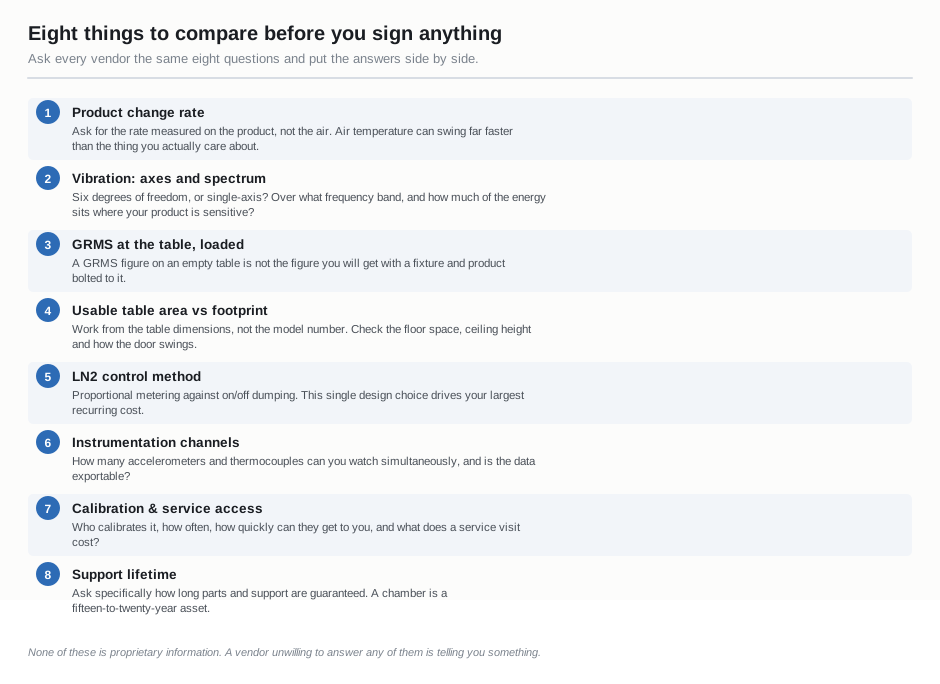
The eight things to compare

1. Product change rate, not air change rate
This is the specification most often misread, and the one most worth getting right.
Air temperature inside a chamber can be made to swing very fast. The temperature of a thermally massive product bolted to a fixture cannot. Since it is the product's rate of change that precipitates defects, an air-temperature figure tells you very little about what the chamber will actually do for you.
Ask for the rate measured on the product, and ask what product was used to measure it. A rate quoted on a bare thermocouple in moving air is not a rate you will ever see on a real assembly. For reference, Hanse specifies 70 °C/min across the −65 °C to +100 °C span on the VTC-4 and above, with a −100 to +200 °C range and control to ±1 °C after stabilisation. The two smallest models differ: the VTC-1 and VTC-1.5 are −75 to +175 °C as standard with −100/+200 optional, and the VTC-1 runs 50 °C/min as standard.
2. Vibration: how many axes, and what spectrum
HALT and HASS depend on repetitive shock vibration — pneumatic hammers striking a table to produce non-coherent broadband energy across six degrees of freedom simultaneously. It excites many resonances at once, in all three translational and all three rotational axes, which is what makes it effective at precipitating defects quickly.
An electrodynamic shaker does something different: precise, controlled, usually single-axis excitation. It is the right tool for qualification testing to a defined spectrum, and the wrong tool for HALT. If a vendor offers a single-axis system for HALT work, understand what you are giving up.
Ask for the frequency range and how the energy is distributed within it. A system specified as tri-axial 6DoF non-coherent broadband across 10 Hz to 10,000 Hz tells you something useful; a bare "up to 10 kHz" does not.
3. Grms at the table — loaded
A Grms figure measured on an empty table is not the figure you will get once a fixture and a product are bolted to it. Ask what load the quoted number assumes. Some systems reach 100 Grms; whether you need that depends entirely on where your product's vibration destruct limit sits, which is one of the things a first HALT tells you.
4. Usable table area versus floor footprint
The table is not the space the chamber occupies, the ceiling height it needs, or the clearance for the door to swing. Check all four before you commit floor space — and check floor loading, because these machines are heavy. A VTC-9 has a nine square foot table and an external envelope of 72 × 55 × 107 inches; the table figure tells you almost nothing about the room you need.
5. How the chamber controls liquid nitrogen

If you go with liquid nitrogen, the control method matters more than almost any other line on the quotation. An on/off solenoid dumps nitrogen and overshoots. A proportional valve meters flow against demand. Over a fifteen-year life on a chamber that runs daily, that single design decision dominates your operating cost.
For reference: Hanse's HighRate LN2 system uses direct atomization in the control plenum with proportional control and a secondary safety shut-off. If you are evaluating another manufacturer, ask them the equivalent question — how does the valve meter flow, and is proportional control standard or an option?
Some manufacturers offer mechanically refrigerated HALT systems, which avoid the nitrogen cost and need no cryogen tank or room oxygen monitoring. That is a real advantage, but it is not the whole comparison. A mechanically refrigerated chamber has to reject its heat somewhere, and at larger sizes that often means chilled water facilities; it is also the more complex machine to maintain. Ask for installed cost and a maintenance plan, not just the chamber price, and count the electricity and chilled water it draws — those usually sit in the facilities budget and never get charged to the chamber, which is why the gap looks wider than it is. The clearer trade is ramp rate. For a settled production HASS screen it can be worth making; for genuine development HALT it usually is not. Hanse chambers are liquid-nitrogen cooled across the range, which is what delivers the 70 °C/min product change rate.
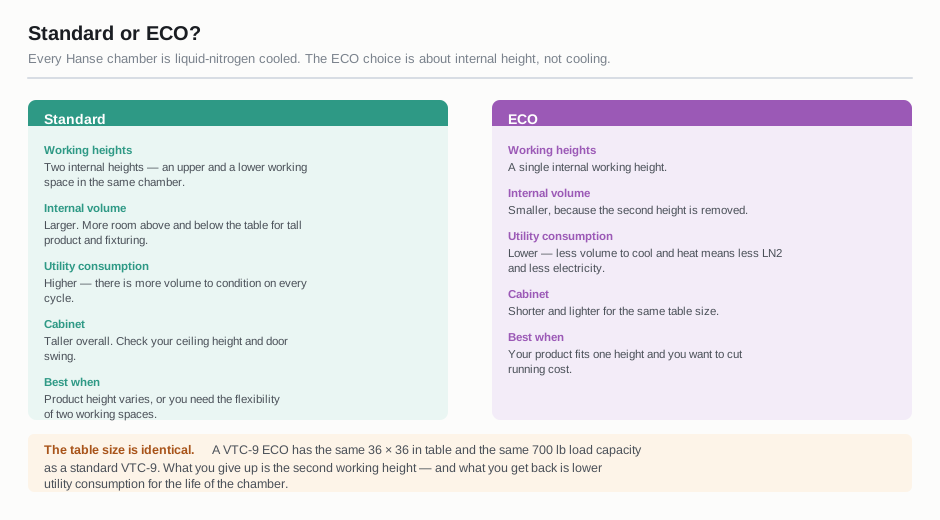
5b. Working heights — the option most buyers miss
A standard Hanse chamber gives you two internal working heights, an upper and a lower space. The ECO variants give you one. The vibration table is identical — a VTC-9 ECO has the same 36 × 36 inch table and the same 700 lb load capacity as a standard VTC-9 — but removing the second height makes the chamber smaller, shorter and lighter, and it consumes less nitrogen and less electricity on every cycle.
If your product fits comfortably in one working height, the ECO configuration lowers both the purchase price and the running cost without touching the table size or the load rating. If your product mix varies in height, the flexibility of the standard configuration is worth paying for. This is a genuinely consequential choice and it is easy to overlook when comparing on table size alone.
6. Instrumentation channels
How many accelerometers and thermocouples can the system monitor at once, and can you get the data out in a usable form? Hanse chambers run ChamberCore™ for programmable temperature and vibration control over Ethernet, with ChamberDAQ data acquisition (to 152 channels) and ChamberFFT vibration analysis (to 16 channels) as options. Specify generously — channels are far cheaper at order time than as a retrofit, and the entire value of the test is in knowing what the product experienced.
7. Calibration and service access
Ask who calibrates it, how often, how far away they are, how quickly they can reach you, and what a service visit costs. A chamber down in the middle of a production screen stops shipments. This is a question about the vendor as much as the equipment, and the answer varies far more between vendors than the specifications do.
8. Support lifetime
A chamber is a fifteen-to-twenty-year asset. Ask specifically how long parts and support are guaranteed, and what happens when the controller generation is superseded. Ask whether controller retrofits are available for older systems — a vendor with a retrofit path is telling you they expect to still be supporting you in a decade.
Sizing: which model fits which job
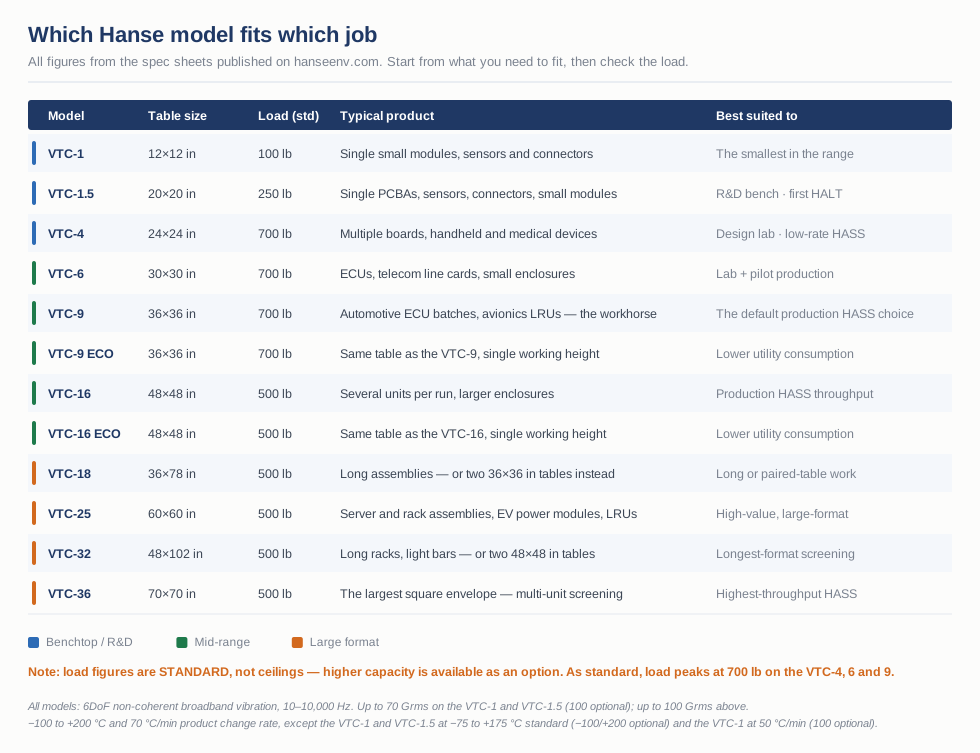
The number in the model name is the nominal table area in square feet, and across most of the range it is exact — a VTC-9 carries a 36 × 36 inch table, which is nine square feet. Two places it is not. The VTC-1.5 has a 20 × 20 inch table, larger than the name suggests, because that table was increased from 18 inches. And the two largest formats, the VTC-32 and the VTC-36, are both close to 34 square feet. Check the dimensions rather than the name. The table below maps the Hanse range to the products and use cases each size suits. The logic transfers to any manufacturer's range; the model names will differ.

Model | Table size | Max load | Best suited to |
VTC-1 | 12 × 12 in | 100 lb | The smallest chamber in the range. Single small modules, sensors and connectors. Standard range is −75 to +175 °C (−100/+200 optional) and 50 °C/min (100 °C/min optional) — the one model that does not run the line’s 70 °C/min. |
VTC-1.5 | 20 × 20 in | 250 lb | Single PCBAs, sensors, connectors and small modules. An R&D bench chamber and a first HALT system. Standard range is −75 to +175 °C, with −100/+200 available as an option. |
VTC-4 | 24 × 24 in | 700 lb | Multiple boards at once, handheld and medical devices. Design lab work and low-rate screening. |
VTC-6 | 30 × 30 in | 700 lb | ECUs, telecom line cards, small enclosures. Lab plus pilot production. |
VTC-9 | 36 × 36 in | 700 lb | Automotive ECU batches and avionics LRUs. The workhorse size and the most common production HASS choice. |
VTC-9 ECO | 36 × 36 in | 700 lb | Same table and load as the VTC-9, single working height, lower utility consumption. |
VTC-16 | 48 × 48 in | 500 lb | Several units per run, larger enclosures. Production HASS throughput. |
VTC-16 ECO | 48 × 48 in | 500 lb | Same table and load as the VTC-16, single working height. |
VTC-18 | 36 × 78 in | 500 lb | Long assemblies. Supplied as either one 36 × 78 in table or two separate 36 × 36 in tables — your choice at order. |
VTC-25 | 60 × 60 in | 500 lb | Server and rack assemblies, EV power modules, large LRUs. |
VTC-32 | 48 × 102 in | 500 lb | The longest format — long racks, light bars, extended battery modules. Also supplied as two separate 48 × 48 in tables instead of one 48 × 102 in. |
VTC-36 | 70 × 70 in | 500 lb | The largest square envelope. Multi-unit production screening. |
Note the load ratings. As standard, maximum load peaks at 700 lb on the VTC-4, VTC-6 and VTC-9 and is 500 lb on every larger chamber — so a bigger table does not automatically mean a higher load rating. These are standard figures, not ceilings: higher load capacity is available as an option across the range. If you are testing something heavy, raise it early rather than sizing around the standard number.
The ECO variants — VTC-9 ECO and VTC-16 ECO — carry the same vibration table and the same load rating as their standard counterparts, but with a single internal working height instead of two. That makes the chamber smaller overall and reduces utility consumption for the life of the machine. If your product fits one height, it is the cheaper choice to buy and to run.
Geometry varies as much as area. The VTC-18 and the VTC-32 are the two long formats, and both are ordered one of two ways: the VTC-18 as a single 36 × 78 inch table or as two 36 × 36 inch tables, the VTC-32 as a single 48 × 102 inch table or as two 48 × 48 inch tables. The single table is longer than the two combined because the paired configuration leaves a gap between them — 78 inches against 72, and 102 against 96. If you run long product, that recovered length is the point of the single-table option. Check the actual dimensions against your product's footprint.
Questions to ask every vendor
Ask all of them, of everyone, and write the answers in a single table. The comparison is far more informative than any individual answer.
What is the temperature change rate measured on a product, and what product did you measure it on?
How many degrees of freedom, and what is the frequency distribution of the vibration energy?
What Grms can I expect at the table with my load, not an empty one?
How does the chamber control liquid nitrogen flow?
What is the total floor footprint, ceiling height and door swing clearance?
How many instrumentation channels are included, and how many can it take?
Who performs calibration, how often, and what does it cost?
How long are parts and support guaranteed, and is there a controller retrofit path?
What is the lead time, and what does installation include?
Can I run my own product in a demonstration before ordering?
Four answers that should give you pause
"Our chamber does 60 °C per minute" — with no further detail
Air or product? Over what span? On what load? A rate quoted without those qualifications is a marketing number, not a specification.
Reluctance to discuss LN2 consumption
It is your largest recurring cost. There is nothing proprietary about how a valve meters flow. A vendor who will not discuss it is either uninformed about their own system or does not want you comparing it.
No demonstration with your product
Running your actual product in the actual chamber before you commit is the single most informative thing you can do. A manufacturer confident in their equipment will encourage it.
Vague support commitments
"We support all our products" is not an answer. How long, with what parts availability, and what happens when this controller generation is discontinued? Get it in writing.
One last thing worth checking
Look at the secondary market for the brands you are considering. Chambers that hold their value and are still being resold and supported fifteen years on tell you something about build quality that no specification sheet will. It also tells you what your own residual value looks like if your testing needs change.
Frequently asked questions
What size HALT chamber do I need?
Start from the physical dimensions of your largest device under test with its fixture attached, then add margin for what you expect to test in five years. The model number is the nominal table area in square feet, so a VTC-9 is a nine square foot table — 36 × 36 inches — which suits typical automotive ECUs and avionics LRUs, while single PCBAs and sensors fit comfortably on the smallest chambers in the range. Check the maximum load separately: as standard it peaks at 700 lb on the VTC-4 through VTC-9 and is 500 lb on every larger chamber, so a bigger table does not automatically carry more. Higher load capacity is available as an option, so ask rather than ruling a chamber out.
What is the most important specification when comparing HALT chambers?
The temperature change rate measured on the product rather than on the air. Air temperature can be made to swing far faster than a thermally massive product, and it is the product's rate of change that precipitates defects. Ask what product the quoted rate was measured on.
Why does HALT need six-degree-of-freedom vibration?
Repetitive shock vibration excites all three translational and all three rotational axes simultaneously with non-coherent broadband energy, which stimulates many resonances at once. That is what makes it effective at precipitating defects quickly. A single-axis electrodynamic shaker produces precise, controlled excitation in one axis, which suits qualification testing but not HALT.
Should I choose a liquid nitrogen or mechanically refrigerated chamber?
Liquid nitrogen delivers the fast product change rates that genuine HALT depends on, and nitrogen is a genuine recurring cost. Mechanical refrigeration avoids that cost and ramps more slowly — but the saving is usually smaller than it looks. The LN2 chamber is typically the simpler machine to buy, a mechanically refrigerated system still has to reject its heat somewhere (chilled water facilities at larger sizes), and it carries the heavier maintenance burden. Those costs are also easy to miss: nitrogen is billed to the chamber because it is usually the only user, while a mechanical system's electricity and chilled water tend to vanish into facility overhead. Compare installed cost and maintenance rather than chamber price, then decide on the product change rate you actually need — that is the difference that does not even out.
How many instrumentation channels do I need?
Count the thermocouples and accelerometers you want to monitor simultaneously on your largest test setup, then add margin. Hanse systems offer ChamberFFT vibration analysis to 16 channels alongside ChamberDAQ data acquisition. Channels cost far less at order time than as a later retrofit.
Can one chamber do both HALT and HASS?
Yes, and it should. Both methods need the same rapid product temperature transitions and the same six-degree-of-freedom repetitive shock vibration, so they run in the same chamber. What differs is the profile, not the equipment.
How long does a HALT/HASS chamber last?
Fifteen to twenty years is a reasonable expectation for a well-built and properly maintained system, which is why parts availability, support lifetime and controller retrofit paths deserve as much attention during evaluation as the specifications do.
Should I buy a used HALT chamber?
It can be sound value. Check the condition of the pneumatic actuators, whether the controller is still supported, whether calibration records exist, and whether the original manufacturer still supplies parts for the model. A brand with an active, supported secondary market is generally a good sign.
Do I need the humidity option?
Only if your product genuinely requires humidity testing. Classic HALT and HASS profiles use thermal and vibration stress only, and a meaningful number of buyers specify humidity and never use it. It is straightforward to justify if your application needs it and an avoidable cost if it does not.
What is the difference between a standard and an ECO chamber?
An ECO chamber has a single internal working height where the standard configuration has two. That makes the chamber smaller and shorter overall and reduces utility consumption on every cycle. The vibration table and the maximum load rating are unchanged — a VTC-9 ECO has the same 36 by 36 inch table and the same 700 lb capacity as a standard VTC-9. If your product fits one working height, the ECO configuration costs less to buy and less to run.
Can I test my own product before buying?
You should insist on it. Running your actual product in the actual chamber is the most informative step in the entire evaluation, and a manufacturer confident in their equipment will encourage it.
Talk to an engineer
Hanse Environmental has been building HALT and HASS chambers in Allegan, Michigan since 1989. If you want to talk through what your product actually needs — before anyone sends you a quote — get in touch and you will speak to someone who builds the equipment, not a call centre.