
top of page
HEI Log
HEI标志

HALT vs HASS: Which Test You Need, and When

2025年10月20日
讀畢需時 9 分鐘

已更新:2天前

HALT and HASS run in the same chamber and apply the same kinds of stress, but they answer different questions. HALT is a development test: it stresses a handful of prototypes past their specification until they stop working and then until they break, to find out where the design's limits actually are. HASS is a production screen: it applies stresses derived from those HALT limits to units coming off the line, to catch defects that testing at nominal conditions would miss. HALT tests the design. HASS tests the build.


That distinction sounds academic until you have to decide which one to budget for, which one your customer is actually asking for, or whether the chamber quote in front of you covers both. This page is about making that decision. If you want the underlying definitions first — what a latent defect is, what operating and destruct limits mean, where ESS fits — start with what ESS, HALT and HASS actually are and come back.


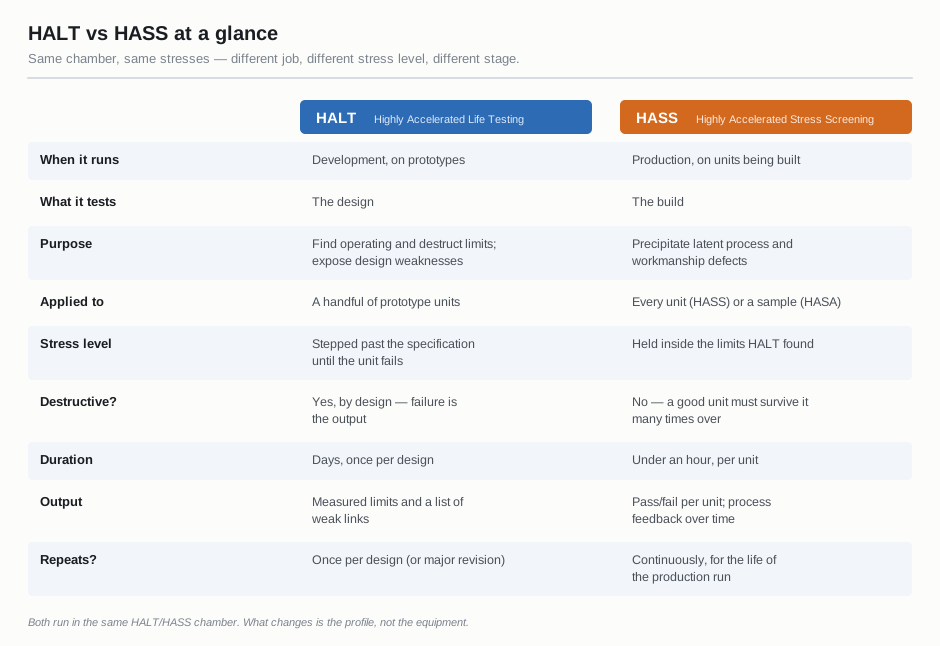
Comparison table showing HALT and HASS side by side across when each runs, what it tests, purpose, what it is applied to, stress level, whether it is destructive, duration, output and how often it repeats
HALT and HASS compared across the nine dimensions that matter to the decision.

The difference in one sentence


HALT deliberately breaks a few prototypes to find out how strong the design is. HASS deliberately does not break production units, while still stressing them hard enough that a bad one fails in your factory rather than at a customer site.


Everything else follows from that. HALT is destructive because breaking things is the point — a HALT that produces no failures simply means you did not push far enough. HASS is emphatically not destructive, because you are shipping the units that pass it. If your HASS screen is consuming meaningful life from good product, the profile is wrong, and the procedure that catches that is Proof of Screen.


Where each one sits in the product lifecycle

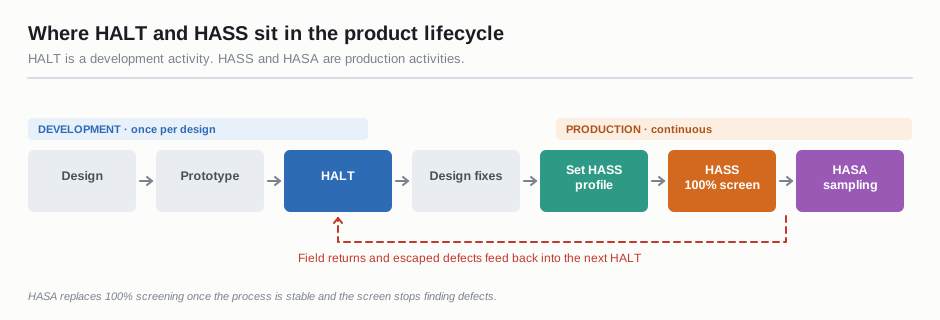
Product lifecycle diagram showing design and prototype leading into HALT, then design fixes, then setting the HASS profile, HASS one hundred percent screening and HASA sampling in production, with field returns feeding back into HALT
HALT is a development activity that happens once per design. HASS is a production activity that runs for the life of the product.

HALT belongs to engineering. It happens once per design — and again after any change significant enough to alter the mechanical construction, thermal mass or component selection. Its output is a set of measured limits and a list of weak links, which the design team then either fixes or consciously accepts.


HASS belongs to manufacturing. It cannot exist without HALT, because the HASS profile is derived from the limits HALT measured. Running a screen without knowing where the destruct limits are is how companies quietly ship product that has already used up part of its life on the test floor.


The dependency runs one way. You can do HALT without ever doing HASS. You cannot responsibly do HASS without having done HALT first — you would be guessing at how hard you can push, on the units you are about to sell.


What actually changes between the two profiles

HALT: step stress until something gives

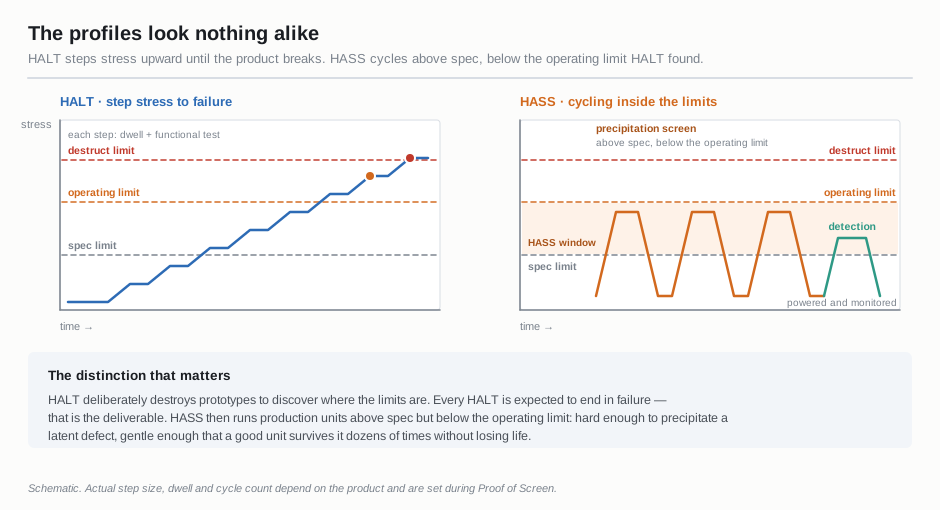
Two charts side by side: a HALT step stress profile climbing past the specification limit, the operating limit and the destruct limit until failure, and a HASS profile cycling between a precipitation stress and a lower detection stress, both above the specification limit and below the operating limit
HALT steps upward until the product fails. HASS cycles inside the limits HALT discovered.

A HALT sequence works through stresses one at a time and then in combination. Cold step stress, hot step stress, rapid thermal transitions, vibration step stress, then combined environment. At each step the product dwells until it is thermally stable and is functionally tested. A common starting point is 10 °C temperature steps, and for vibration, 5 Grms measured over a 10 Hz to 5 kHz bandwidth, stepping in 5 Grms increments. The full step-by-step procedure is in our HALT and HASS methodology guide.


Two limits get recorded in each direction. The operating limit is where the product stops functioning correctly but recovers when the stress is removed. The destruct limit is where it does not recover. The gap between your specification and those limits is your design margin, and it is the number HALT exists to produce.


HASS: precipitate, then detect


A HASS profile has two phases doing two different jobs. The precipitation screen runs at elevated stress — typically above the product specification but below the operating limits HALT found — to turn a latent defect into a real, detectable one. A cracked solder joint that would have failed in eighteen months in the field becomes an open circuit in the chamber. The detection screen then runs at lower stress with the product powered and monitored, because a defect you precipitated but did not detect is worse than useless: you have consumed life and shipped the unit anyway.


The whole sequence has to fit inside a production takt time, which in practice means well under an hour per unit.


Do you need both?

Your situation

What you need

Why

Designing a new product, no production yet

HALT only

You need design margin data. There is nothing to screen yet.

Low volume, high mix, high value (aerospace, defense, medical)

HALT, plus HASS on every unit

The cost of a field failure vastly exceeds the cost of screening, and volumes are low enough that 100% screening is practical.

High volume, stable process (automotive, consumer electronics)

HALT, HASS at launch, then HASA

Screen everything through ramp-up, then move to sampling once the process proves stable and the screen stops finding defects.

Contract manufacturer screening someone else's design

HASS, using the customer's HALT data

You are testing the build, not the design. You need their limits — do not invent your own.

Chasing an existing field failure

HALT on the failing design

HALT finds the weak link far faster than field data does, and tells you whether it is a design problem or a process one.

Qualifying against MIL-STD-810 or IEC 60068

Neither, on its own

Those are qualification standards with defined profiles. HALT and HASS are discovery and screening methods. They are complementary, not substitutes — see below.

How this relates to MIL-STD-810, IEC 60068 and ESS


This is where the terminology causes the most confusion, so it is worth being blunt.


MIL-STD-810 and IEC 60068-2 are qualification standards. They specify defined environmental profiles a product must survive to be considered qualified. The stresses are intended to represent the service environment. You pass or you fail.


HALT is not a qualification test and cannot be used as one. The stresses are deliberately unrepresentative — that is the whole mechanism. It does not produce a pass, and it cannot produce an MTBF or a life prediction, because there is no acceleration factor being calculated. Anyone who tells you their HALT results demonstrate compliance with a standard has misunderstood one or the other.


Classical ESS is HASS's predecessor. Profiles like NAVMAT P-9492 and MIL-HDBK-2164A prescribed fixed screening levels — 6 Grms random vibration, defined thermal cycles — applied to every product regardless of what it was. HASS replaced the fixed profile with one derived from the specific product's measured limits, which is both more effective and less damaging. IPC-9592B is the more current reference for power conversion equipment.


A useful way to hold it: qualification asks "does it meet the spec?" HALT asks "how much better than the spec is it?" HASS asks "was this particular unit built correctly?" Three different questions. Most products that matter need answers to all three.


Can one chamber do both?

Yes — and it has to, because the two methods make almost identical demands on the equipment. Both need rapid thermal transitions measured on the product rather than the air, and both need six-degree-of-freedom repetitive shock vibration rather than single-axis sine or random.


What a HALT/HASS chamber has to deliver:

Capability

Typical requirement

Why it matters

Temperature range

Up to −100 °C to +200 °C

HALT needs headroom well past the product specification, or you find the chamber's limit instead of the product's. Range is configured per model — smaller chambers ship with a narrower standard range and can be optioned up.

Product change rate

60–70 °C/min on the product

Rate of change is a stress in its own right. Slow ramps do not precipitate the same defects.

Vibration type

6-DoF repetitive shock, non-coherent broadband

Excites all axes and many resonances at once. Single-axis shakers do not reproduce it.

Vibration bandwidth

10 Hz to 10,000 Hz

Latent defects at solder joints and interconnects respond at high frequency.

Vibration level

Up to 100 Grms on some systems

HALT needs enough headroom to reach the vibration destruct limit.

Instrumentation

Multi-channel accelerometer and thermocouple input

You need to see what the product experienced, not what the chamber was told to do. On Hanse systems this is ChamberFFT, to 16 accelerometer channels, and ChamberDAQ, to 152 channels (24 on the Watlow F4T plus 128 external thermocouple channels).

Hanse builds its VTC HALT/HASS chambers on this architecture, from a 12 × 12 inch benchtop table up to 70 × 70 inches. If you are working out which size fits your product, the HALT/HASS chamber buyer's guide has a model-by-model breakdown.


Four mistakes worth avoiding


Running HASS without Proof of Screen


Proof of Screen validates the profile before it touches saleable product. Safety of screen demonstrates the profile does not damage good units — typically by running known-good product through it 20 to 50 times and confirming nothing degrades. Effectiveness of screen demonstrates it actually precipitates defects, usually with seeded-defect units or no-fault-found field returns. Skipping it means you do not know whether you are screening or slowly damaging inventory.


Reusing a HASS profile on a different product


The limits are specific to a product's mechanical construction, thermal mass and components. A new product — or a significant revision — needs its own HALT and its own Proof of Screen. A profile that was safe for one assembly can be destructive for another that looks superficially similar.


Treating a HALT failure as a defect report


Failures are the output, not a problem with the test. The engineering question is never "why did it fail?" but "is this margin enough, and if not, what is the cheapest fix?" Some discovered weaknesses are worth engineering out. Others are far enough beyond any real service condition that the right answer is to document them and move on.


Buying a chamber sized for today's product


A chamber is a fifteen-to-twenty-year asset. The product that justifies the purchase is rarely the last one that will go in it. Sizing to the current DUT with no margin is the most common regret we hear about. If you are building the budget case, the HALT/HASS chamber cost guide covers what drives the price.


Frequently asked questions

What is the difference between HALT and HASS?


HALT is a development test that stresses prototypes beyond their specification to find operating and destruct limits and expose design weaknesses. HASS is a production screen that applies stresses derived from those HALT limits to units being manufactured, to catch process and workmanship defects. HALT tests the design; HASS tests the build.


Can you do HASS without doing HALT first?


Not responsibly. The HASS profile is derived from the operating and destruct limits that HALT measures. Without them you are guessing at how much stress the product can take, on units you intend to sell — which risks either screening too gently to find anything or consuming life from good product.


Is HALT destructive?


Yes, deliberately. HALT continues until the product reaches its destruct limit or the chamber runs out of capability. A HALT that produces no failures means the stress was not taken far enough. Prototypes used for HALT are consumed by it.


Is HASS destructive?


No. A correctly designed HASS profile stays inside the limits HALT found, and Proof of Screen demonstrates that good units survive it many times over without measurable degradation. If HASS is damaging good product, the profile is wrong.


Do HALT and HASS use the same chamber?


Yes. Both need the same two capabilities — rapid product temperature change rates and six-degree-of-freedom repetitive shock vibration — so they run in the same HALT/HASS chamber. What changes between them is the profile, not the equipment.


How long does each one take?


A HALT typically runs over several days and happens once per design. A HASS screen has to fit inside a production cycle, so it is usually well under an hour per unit and runs continuously for the life of the product.


What is HASA and when do you switch to it?


HASA — Highly Accelerated Stress Audit — applies the HASS profile to a sample of each production lot rather than to every unit. It is appropriate once the manufacturing process has proven stable and the screen has stopped yielding failures. Switching too early forfeits the protection HASS provides.


Does HALT replace MIL-STD-810 or IEC 60068 qualification testing?


No. Those are qualification standards with defined, representative profiles and a pass/fail outcome. HALT uses deliberately unrepresentative stress to discover limits and produces no pass. They answer different questions and most regulated products need both.


Can HALT predict how long my product will last?


No. HALT applies stresses that do not represent field conditions and calculates no acceleration factor, so it cannot produce an MTBF or a life prediction. What it produces is a set of measured limits and a ranked list of weak links.


We only build a few hundred units a year. Is HASS worth it?


Usually yes, and often more than at high volume. Low-volume products tend to be high-value ones where a single field failure costs more than a year of screening — and at low volume, 100% screening is practical rather than a throughput problem.


Talk to an engineer

Hanse Environmental has been building environmental stress screening equipment in Allegan, Michigan since 1989, and HALT/HASS systems for more than three decades. If you want to talk through what your product actually needs — before anyone sends you a quote — get in touch and you will speak to someone who builds the equipment, not a call centre.


bottom of page