

Liquid nitrogen (LN2) is usually the largest recurring cost of a HALT chamber in regular use. How much a chamber uses depends on how it controls LN2 flow, how much it has to cool (the chamber, its table and the product), how far it has to cool it, and how long the profile holds cold. In Hanse's experience, ramp rate is not what drives it.
LN2 is usually the largest running cost
For an LN2 chamber in regular use, nitrogen is usually the largest recurring line in the running costs. Every Hanse chamber is cooled by liquid nitrogen direct injection. A vacuum-jacketed proportional LN2 valve is standard on the VTC-4 and TC-4 and up, and proportional control is optional on the VTC-1.5.
Proportional control or on/off
How a chamber meters LN2 matters more than anything else on this page. An on/off solenoid dumps nitrogen to reach set point and then overshoots. A proportional valve meters LN2 against actual demand. The result is less LN2, and a longer service life for the valve.
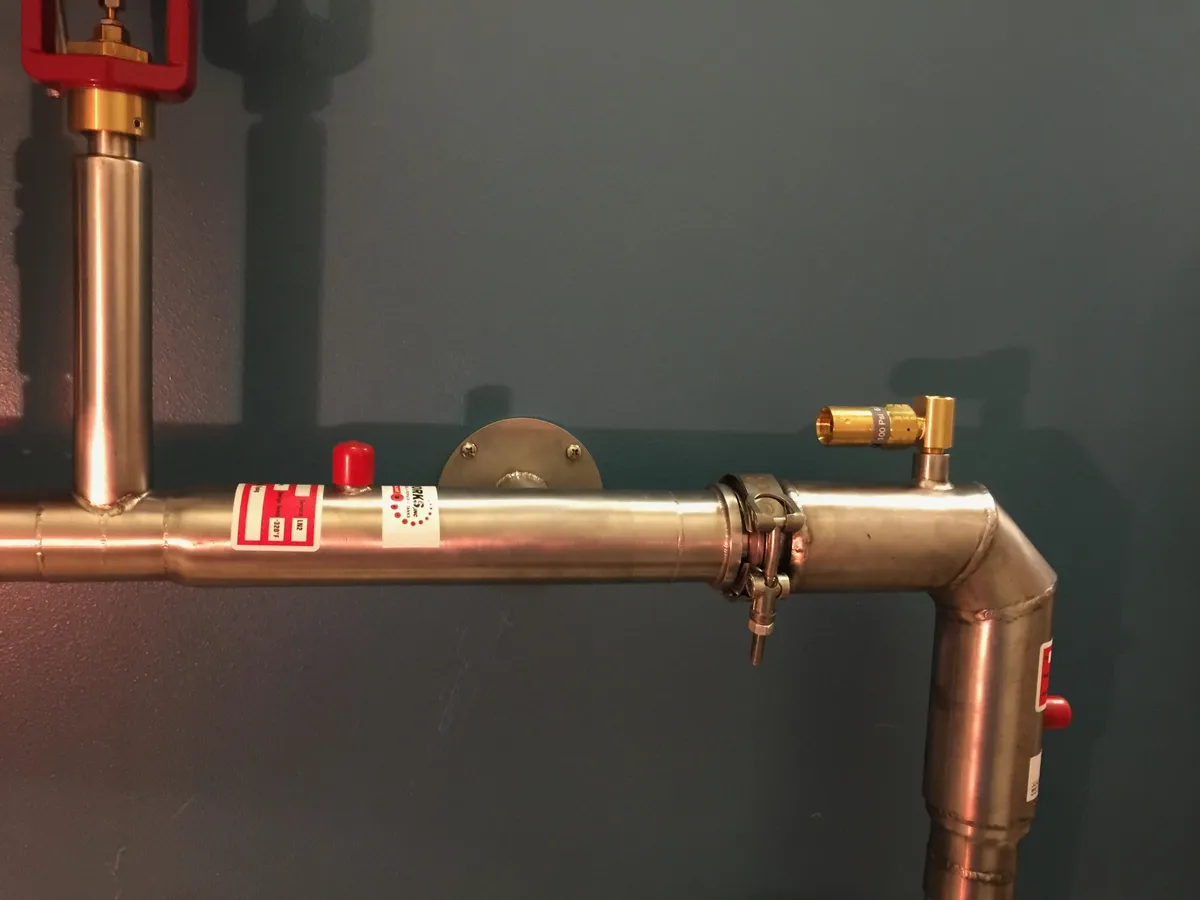
If you own a chamber with on/off LN2 control, a vacuum-jacketed proportional valve can be fitted as an upgrade.
A faster ramp does not use more nitrogen
In Hanse's experience, ramp rate does not drive LN2 consumption: a faster ramp does not use more nitrogen than a slower one. The heat that has to be removed to change the chamber's temperature, in BTUs, is the same whatever the ramp rate; a faster ramp only removes it sooner. The factors that do drive consumption are below.
Temperature span
The nitrogen needed to reach a cold set point rises in direct proportion to the temperature span. In Hanse's LN2 calculator, a pull-down from +80 °C to −40 °C takes twice the nitrogen of one from +20 °C to −40 °C.
Cold dwell time
Holding a cold set point keeps using nitrogen. In Hanse's calculator, the first 5 minutes of a cold dwell add about half the nitrogen it took to reach set point, the next 5 minutes about a quarter, and every 5 minutes after that about an eighth. A 20-minute cold dwell roughly doubles the nitrogen of the pull-down, and a 60-minute dwell roughly triples it. Hot dwells use no LN2, so in a thermal cycle the cold side carries the nitrogen bill.
Chamber size
Consumption scales with the conditioned volume and the mass of the table: the bigger the chamber, the more nitrogen it uses. Across the VTC line, the nitrogen needed to reach set point rises about four to five times from the VTC-4 to the VTC-36. Size the chamber from your product, as the buyer's guide explains, rather than buying larger than you need.
The product and its fixture
Everything on the table has to be cooled too. A powered product adds heat that the LN2 has to remove for as long as it runs cold. The product and its fixture add to every pull-down in proportion to their weight and specific heat: per pound, aluminum and magnesium take about twice the nitrogen of steel to cool through the same span.
ECO models use less
An ECO model uses less LN2 than the standard model of the same size. It has a single 38-inch (965 mm) working height in place of the standard 38-inch and 50-inch (965 and 1,270 mm) heights, so its interior is smaller, with the same table and the same load. In Hanse's LN2 calculator, the VTC-9 ECO needs about a tenth less nitrogen to reach set point than a standard VTC-9 with its table in the high position, which leaves the same 38-inch (965 mm) working space, and nearly a quarter less than with the table in the low position, which leaves 50 inches (1,270 mm).
What the site needs
An LN2 chamber also needs site infrastructure: a tank, vacuum-jacketed pipe and oxygen monitoring in the room. Supply ranges from delivered dewars to micro-bulk and bulk tanks, depending on how much nitrogen the chamber uses.
LN2 or mechanical refrigeration
LN2 is the most visible running cost a chamber has. It is usually the only thing on site using nitrogen, so the bill arrives with the chamber's name on it, while the electricity and chilled water a mechanically refrigerated chamber draws are rarely charged to it at all. The cost guide compares the two routes in full.