
VTC series (Vibration Thermal Chamber) · built in Allegan, Michigan
HALT & HASS Test Chambers
Combined thermal and vibration chambers engineered for HALT and HASS: −100 to +200 °C, a 70 °C/min product change rate*, and tri-axial six-degree-of-freedom repetitive shock vibration from 10 to 10,000 Hz in the same chamber. Twelve standard models, from a 12 × 12 in (305 × 305 mm) bench system to a 70 × 70 in (1,778 × 1,778 mm) production chamber.
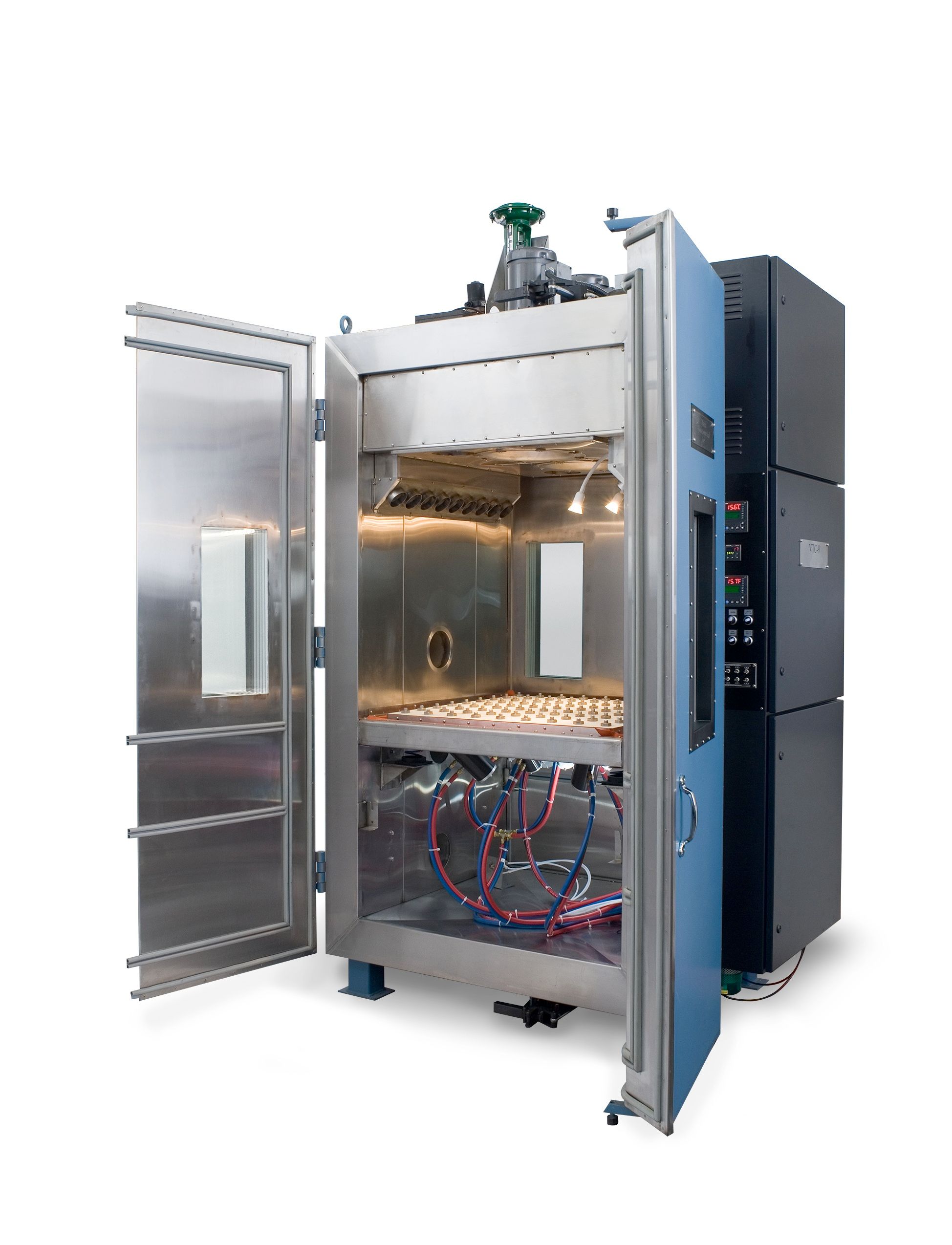
- temperature range†
- −100 to +200 °C
- product change rate*
- 70 °C/min
- 6-DoF repetitive shock
- 10–10,000 Hz
- maximum vibration level
- 100 GRMS
- 12 × 12 to 70 × 70 in (305 × 305 to 1,778 × 1,778 mm)
- 12 models
*Measured 4" above center of table, −65 °C to +100 °C.
†VTC-4 and up. The VTC-1 and VTC-1.5 run −75 to +175 °C as standard (−100/+200 °C optional); the VTC-1 is 50 °C/min (100 °C/min optional). Extended ranges down to −150 °C and up to +400 °C are available as options.
One chamber, both methods
HALT and HASS make almost identical demands on equipment: fast product temperature change, and broadband vibration in all six degrees of freedom. What changes between them is the profile, not the machine. Every VTC chamber runs both.
Not sure which method you need? Start with HALT vs HASS. Planning a budget? See what drives chamber cost.
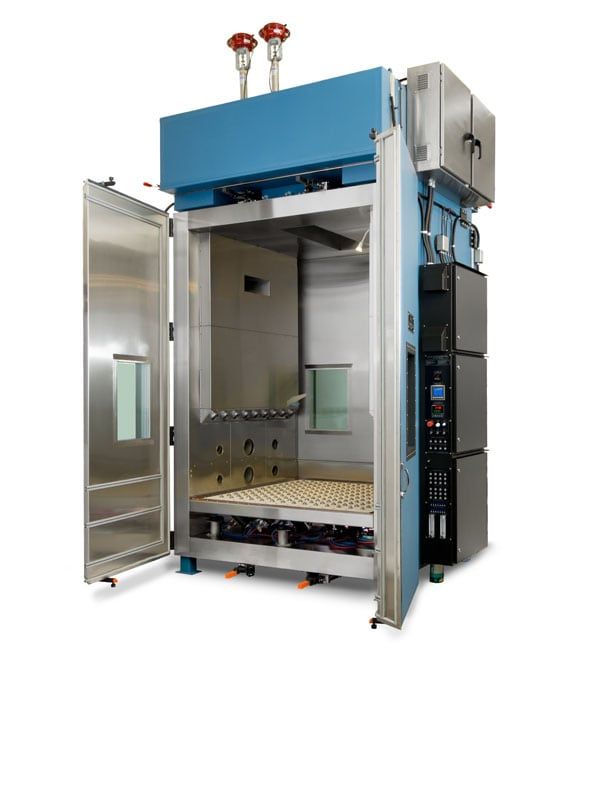
Performance
What the chamber does, and why it matters
- Temperature range
- −100 to +200 °C
- Enough headroom to pass the destruct limits of most electronics, so you find the product's limit, not the chamber's. Extended to −150 °C and +400 °C as an option.
- Product change rate*
- 70 °C/min, −65 to +100 °C
- Rate of change is itself a stress. *Measured 4" above center of table, −65 °C to +100 °C.
- Temperature control
- ±1 °C after stabilization
- Short dwell times keep a HASS screen from slowing the production line.
- Cooling
- Liquid nitrogen, direct atomization in the control plenum
- Proportional LN2 control on VTC-4 and up (optional on VTC-1.5), with a secondary safety shut-off.
- Vibration
- Tri-axial 6-DoF, non-coherent broadband, 10–10,000 Hz
- Excites all three translational and all three rotational axes at once, stimulating many resonances simultaneously.
- Vibration level
- Up to 100 GRMS (70 GRMS on VTC-1 and VTC-1.5, 100 optional)
- Headroom to reach the vibration destruct limit on most assemblies. Ultra-Hi vibration performance option on the VTC-16, VTC-16 ECO, VTC-25, VTC-32 and VTC-36, chamber or standalone.
- Vibration table
- Ceramic-coated, 90% of energy in 10–4,000 Hz
- Energy concentrated where most real structural resonances sit; the coating insulates the table from its base.
The range
Twelve standard models
Every model shares the same architecture and control system. Full specifications are on each model's spec sheet; the buyer's guide walks through how to size one.
| Model | Table | Internal (W × D × H) | Max load |
|---|---|---|---|
| VTC-1 | 12 × 12 in (305 × 305 mm) | 18 × 18 × 18 in (457 × 457 × 457 mm) | 100 lb (45 kg) |
| VTC-1.5 | 20 × 20 in (508 × 508 mm) | 24 × 24 × 23/34 in (610 × 610 × 584/864 mm) | 250 lb (113 kg) |
| VTC-4 | 24 × 24 in (610 × 610 mm) | 30 × 30 × 36 in (762 × 762 × 914 mm) | 700 lb (318 kg) |
| VTC-6 | 30 × 30 in (762 × 762 mm) | 36 × 36 × 36 in (914 × 914 × 914 mm) | 700 lb (318 kg) |
| VTC-9 | 36 × 36 in (914 × 914 mm) | 42 × 42 × 38/50 in (1,067 × 1,067 × 965/1,270 mm) | 700 lb (318 kg) |
| VTC-9 ECO | 36 × 36 in (914 × 914 mm) | 42 × 42 × 38 in (1,067 × 1,067 × 965 mm) | 700 lb (318 kg) |
| VTC-16 | 48 × 48 in (1,219 × 1,219 mm) | 54 × 54 × 38/50 in (1,372 × 1,372 × 965/1,270 mm) | 500 lb (227 kg) |
| VTC-16 ECO | 48 × 48 in (1,219 × 1,219 mm) | 54 × 54 × 38 in (1,372 × 1,372 × 965 mm) | 500 lb (227 kg) |
| VTC-18 | 36 × 78 in (914 × 1,981 mm) / 2 × 36 × 36 in (914 × 914 mm) | 42 × 84 × 38/50 in (1,067 × 2,134 × 965/1,270 mm) | 500 lb (227 kg) |
| VTC-25 | 60 × 60 in (1,524 × 1,524 mm) | 66 × 66 × 38/50 in (1,676 × 1,676 × 965/1,270 mm) | 500 lb (227 kg) |
| VTC-32 | 48 × 102 in (1,219 × 2,591 mm) / 2 × 48 × 48 in (1,219 × 1,219 mm) | 54 × 108 × 38/50 in (1,372 × 2,743 × 965/1,270 mm) | 500 lb (227 kg) |
| VTC-36 | 70 × 70 in (1,778 × 1,778 mm) | 76 × 76 × 38/50 in (1,930 × 1,930 × 965/1,270 mm) | 500 lb (227 kg) |
Construction and utilities
| Model | Doors | Windows | Electrical | LN2 supply | Compressed air |
|---|---|---|---|---|---|
| VTC-1 | One, front | One heated multi-pane window, 9 × 9 in (229 × 229 mm), in the door | 240 V, 3-phase, 30 FLA | 3/8 in | 1/2 in supply, 15 SCFM (25 m³/h) |
| VTC-1.5 | One, front | One heated multi-pane window, 12 × 12 in (305 × 305 mm), in the door | 480 V, 3-phase, 50 FLA | 3/8 in | 1/2 in supply, 25 SCFM (42 m³/h) |
| VTC-4 | Two, front and rear | Two heated multi-pane windows, 20 × 20 in (508 × 508 mm), one in each door | 480 V, 3-phase, 60 FLA | 1/2 in | 3/4 in supply, 45 SCFM (76 m³/h) |
| VTC-6 | Two, front and rear | Two heated multi-pane windows, 20 × 20 in (508 × 508 mm), one in each door | 480 V, 3-phase, 65 FLA | 1/2 in | 3/4 in supply, 55 SCFM (93 m³/h) |
| VTC-9 | Two manual doors: one front, one rear | Two heated multi-pane windows, 20 × 20 in (508 × 508 mm), one in each door | 480 V, 3-phase, 125 FLA | 1/2 in | 1 in supply, 120 SCFM (204 m³/h) |
| VTC-9 ECO | Two manual doors: one front, one rear | Two heated multi-pane windows, 20 × 20 in (508 × 508 mm), one in each door | 480 V, 3-phase, 125 FLA | 1/2 in | 1 in supply, 120 SCFM (204 m³/h) |
| VTC-16 | Two manual doors: one front, one rear | Two heated multi-pane windows, 20 × 20 in (508 × 508 mm), one in each door | 480 V, 3-phase, 150 FLA | 1/2 in | 1 in supply (1.25 in with Ultra-Hi), 100 SCFM (170 m³/h); 200 SCFM (340 m³/h)* |
| VTC-16 ECO | Two manual doors: one front, one rear | Two heated multi-pane windows, 20 × 20 in (508 × 508 mm), one in each door | 480 V, 3-phase, 125 FLA | 1/2 in | 1 in supply, 100 SCFM (170 m³/h); 200 SCFM (340 m³/h)* |
| VTC-18 | Bi-parting doors, front and rear | Four heated multi-pane windows, 12 × 24 in (305 × 610 mm), one in each door | 480 V, 3-phase, 170 FLA | 2 × 1/2 in | 1.25 in supply, 240 SCFM (408 m³/h) |
| VTC-25 | Bi-parting doors, front and rear | Four heated multi-pane windows, 12 × 24 in (305 × 610 mm), one in each door | 480 V, 3-phase, 170 FLA | 1 in | 1.25 in supply (1.5 in with Ultra-Hi), 150 SCFM (255 m³/h); 300 SCFM (510 m³/h)* |
| VTC-32 | Bi-parting doors, front and rear | Four heated multi-pane windows, 12 × 24 in (305 × 610 mm), one in each door | 480 V, 3-phase, 170 FLA | 2 × 1/2 in | Two 1 in supplies, 200 SCFM (340 m³/h); 400 SCFM (680 m³/h)* |
| VTC-36 | Bi-parting doors, front and rear | Four heated multi-pane windows, 12 × 24 in (305 × 610 mm), one in each door | 480 V, 3-phase, 245 FLA | 1 in | 1.25 in supply (1.5 in with Ultra-Hi), 225 SCFM (382 m³/h); 450 SCFM (765 m³/h)* |
*With the Ultra-Hi vibration option (twice the pneumatic vibrators).
Size on load as well as table area
Standard load peaks at 700 lb (318 kg) on the VTC-4, VTC-6 and VTC-9 and is 500 lb (227 kg) on the larger chambers. Higher load capacity is available as an option across the range.
Standard or ECO
ECO models have the same table and load rating as the standard chambers, but a single 38-inch (965 mm) working height in place of the standard 38-inch and 50-inch (965 and 1,270 mm) heights. The chamber is smaller and uses less utility on every cycle. The VTC-18 and VTC-32 can take one long table or two square ones.
Control and instrumentation
One profile for temperature and vibration
Watlow + ChamberCore
Watlow controllers run through Hanse's ChamberCore software: programmable temperature, humidity and GRMS ramps in a single profile over Ethernet, so a combined-stress step runs as one instruction. Older chambers, including other makers', can be upgraded to the same control.
Explore ChamberCore and the live demo →ChamberDAQ — expandable data acquisition
24 universal inputs on each Watlow F4T (thermocouple, RTD, mA, mV/V), with more F4Ts for more inputs, plus up to eight WebDAQ modules for 128 external thermocouple channels. Standard instrumentation includes one air and one specimen thermocouple.
ChamberFFT — to 16 channels
Real-time vibration analysis on up to 16 simultaneous IEPE accelerometer channels at 25,600 samples per second: GRMS, power spectral density, shock response spectrum, rainflow fatigue and fatigue damage spectrum. GRMS values feed the Watlow controller for closed-loop control from one accelerometer or an average of several.
Full ChamberFFT specification →System features
Built for fast, controlled stress
Variable-output control throughout
Heating, LN2 cooling and vibration are all driven proportionally, never simple on/off switching. That cuts LN2 consumption substantially and extends heater life.
Adjustable air flow plenum
At least four 3 in ports to direct airflow onto the product (VTC-4 and up).
LubeMist vibrators
An adjustable ball valve on every pneumatic vibrator, for low-G performance using fewer vibrators.
SoftStart
Vibrators designed to minimize starting shock to the product.
Balanced GRMS on all six axes
X, Y and Z plus roll, pitch and yaw, typically within ±25% of each other, with minimal fixture investment.
Complete turnkey system
Chamber, vibration fixtures and LN2 system with installation, piping and controls, plus global product support.
Why zero-cross SCR heating lasts longer
On/off control swings the heater element above and below set point. Every swing expands and contracts the element wire, which work-hardens it until it breaks. Hanse fires its heaters with zero-cross SCRs: solid-state power control that switches on the AC zero crossing every cycle, holding the element at a steady temperature with no contacts to wear out.
- switching cycle of a mechanical contactor
- 30 s+
- switching cycle of a zero-cross SCR (one 60 Hz AC cycle)
- 16.6 ms
- longer heater life with SCR control than with a contactor, in Watlow's accelerated heater life testing
- Up to 20×
Options
Configure it to your product
- Extended temperature — down to −150 °C and up to +400 °C, as an option or custom build.
- Humidity — direct water injection or a steam generator, 10 to 85% RH from 25 to 65 °C, with a capacitance sensor.
- Fixtures — designed for your assembly, with metric or inch hole patterns.
- More channels — specify at order; channels are far cheaper than a retrofit.
- Access ports — extra ports, 6 in or custom sizes, for cabling and powered functional test.
- Higher load capacity — available across the range.
- LN2 system — complete installation, piping and controls.
Built to be lived with
A fifteen-to-twenty-year asset
- 3-year warranty on vibrators and vibration tables.
- 1-year equipment warranty from shipment: parts and labor for the first 90 days, then parts at no cost other than travel.
- FM-approved safety — independent over/under limit control, door interlocks, emergency power off.
- UL / CE components — built to NEC code with three-phase monitoring.
- Supported for the long term — including controller retrofits for older systems.
- Built in Allegan, Michigan — designed, fabricated and supported in the US since 1993.
Beyond the standard range
Thermal only, vibration only, or custom
Frequently asked questions
What is the difference between a HALT chamber and a standard environmental chamber?
A HALT chamber delivers rapid product temperature change rates — around 70 °C per minute, measured 4" above the center of the table from −65 °C to +100 °C — and tri-axial six-degree-of-freedom repetitive shock vibration in the same chamber. A conventional thermal chamber does neither, so it cannot precipitate the defects HALT and HASS depend on.
What size HALT chamber do I need?
Start from your largest device under test with its fixture attached, and allow margin for what you expect to test in five years. Then check load as well as table area: standard load peaks at 700 lb (318 kg) on the VTC-4, VTC-6 and VTC-9 and is 500 lb (227 kg) on the larger chambers, with higher load capacity available as an option. The twelve standard tables run from 12 × 12 in (305 × 305 mm) to 70 × 70 in (1,778 × 1,778 mm).
What temperature range and change rate do Hanse chambers achieve?
From the VTC-4 up, the standard range is −100 to +200 °C with a 70 °C/min product change rate* and control to ±1 °C after stabilization. The VTC-1 and VTC-1.5 run −75 to +175 °C as standard, with −100/+200 °C optional, and the VTC-1 is 50 °C/min standard, with 100 °C/min optional. Extended ranges down to −150 °C and up to +400 °C are available as options. *Measured 4" above center of table, −65 °C to +100 °C.
What vibration does a Hanse HALT chamber produce?
Tri-axial six-degree-of-freedom, non-coherent broadband repetitive shock from 10 to 10,000 Hz, up to 100 GRMS (70 GRMS standard on the VTC-1 and VTC-1.5), generated by pneumatic actuators striking a ceramic-coated table. An Ultra-Hi vibration performance option is available on the VTC-16, VTC-16 ECO, VTC-25, VTC-32 and VTC-36. It is a different mechanism from a single-axis electrodynamic shaker, and it is what makes HALT effective.
What is the difference between a standard and an ECO chamber?
An ECO chamber has a single 38-inch (965 mm) internal working height; the standard model has two, 38 and 50 inches (965 and 1,270 mm). The vibration table and standard load rating are the same — a VTC-9 ECO has the same 36 × 36 in (914 × 914 mm) table and 700 lb (318 kg) rating as a standard VTC-9 — but the chamber is smaller overall and uses less utility on every cycle. ECO versions are offered on the VTC-9 and VTC-16.
Can one chamber run both HALT and HASS?
Yes. Both methods need the same fast product temperature change and the same six-degree-of-freedom vibration. What differs is the profile, not the equipment, and every VTC model runs both.
What software controls the chamber?
Watlow controllers run through Hanse's ChamberCore software, which programs temperature, humidity and vibration in a single profile over Ethernet. ChamberDAQ adds data acquisition (24 universal inputs on each Watlow F4T, with more F4Ts for more inputs, plus up to eight WebDAQ modules for 128 external thermocouple channels), and ChamberFFT adds vibration analysis on up to 16 accelerometer channels. A live demo is available at chambercore.app.
Why do Hanse chambers use SCR heater control instead of on/off?
On/off control swings the heater element above and below set point, and that repeated expansion and contraction is what wears heater wire out. Hanse fires its heaters with zero-cross SCRs, which switch every AC cycle and hold the element at a steady temperature. In Watlow's accelerated heater life testing, SCR control gave up to 20 times longer heater life than on/off switching with mechanical contactors.
What do VTC, TC, VS and VK stand for?
VTC is a Vibration Thermal Chamber, combining temperature and six-degree-of-freedom vibration for HALT and HASS. TC is a Thermal Chamber, without vibration. VS is a standalone Vibration System. VK is a Vibration Kit: the table and actuators supplied to integrate into an existing chamber or another system.
Can we test our product before we buy?
Yes. Hanse runs HALT and HASS in-house on customers' own units, so you can see what the method finds on your product before you invest in a chamber. Contact us to arrange an evaluation.
Talk to the people who build it
Tell us what you are testing and we will tell you which model fits — or whether you need one at all. Not sure HALT will work on your product? We can run it in-house on your units before you invest.